Our goal is to provide a family centered team approach that coordinates all services being provided so the child can get the maximum benefit from his or her total program. In addition, we provide parent and family training, offer information regarding parent and family support groups, as well as resource information.
Our special educators and therapists co-teach the class. Each staff member is specially trained to work with
sensory dysregulation, motor planning, and communication difficulties. We infuse technology into our
experience-based learning activities throughout the day.
We also have the opportunity for integrating typical peers in regular education with our students via reverse mainstreaming opportunities both on an individual and small group basis.
Location:
The Creekside School
540 Sands Drive
San Jose, CA 95125
Hours of classroom operation:
Monday through Thursday 9:00 a.m. to 2:30 p.m.
Friday 9:00 a.m. to 12:30 p.m.
Our staff participates in weekly in-service trainings on Friday afternoons. Our regular school year is 182 days with 20 days of extended school year during the summer months.
Our Speech-Language Pathologist (SLP) helps our children communicate using speech, sign language, Picture Exchange Communication System (PECS), voice output devices, and other assistive technology. These tools are implemented according to the unique needs of each child. Our SLP also addresses motor speech difficulties, auditory processing issues, as well as other communication related difficulties our students may encounter. This Total Communication Approach teaches our students the tools necessary to communicate functionally across environments and allows for student-directed communication. Our students learn multiple ways to initiate and respond to people, make their wants and needs known, and appropriately comment on their surroundings. [Back to the top]
Occupational TherapyOccupational therapy (OT) addresses a person’s ability to interpret and use their senses (hearing, sight, touch, taste, and smell) effectively to regulate their response to the environment. Through treatment, students can achieve optimal levels of functioning while at school, home, and in the community. OT also addresses how a student uses their body in a variety of ways. Therapeutic goals can address gross and fine motor development, visual-perceptual skills, sensory modulation, motor sequencing, self-care, independent living, and prevocational skills. Students are provided with opportunities to receive beneficial sensory input as needed, thus enabling them to participate more fully in their daily activities. In addition to individual and group services, the occupational therapy department offers consultative services to the student's families and to the school staff. [Back to the top]
Twice a week a registered music therapist engages our students through music. Music is a powerful teaching modality that is highly accessible for individuals with physical and cognitive challenges. Because music impacts physiological functioning on a variety of levels, it is an effective way to stimulate movement and help students become more alert, engaged, and excited about learning. Research findings from the fields of music therapy and special education support the positive effects of music as a therapeutic tool for individuals with multiple disabilities. Documented results include increases in verbal responding, decreases in stereotyped behavior, learning of anticipatory, imitative, and initiating behaviors, improvements in purposeful hand use, improved visual attention, and greater activation of augmentative devices. [Back to the top]
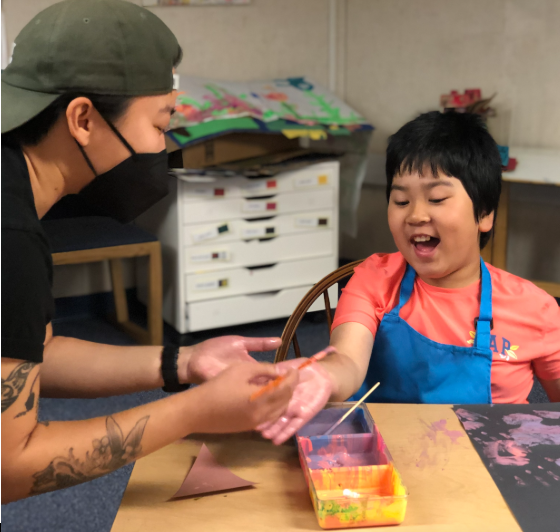
ArtAccording to the American Art Therapy Association, art therapy is based on the belief that the creative process of art is both healing and life-enhancing. Though art is included in daily activities as a way for the students to develop self-expression, Creekside provides one weekly art session from a dedicated art teacher. [Back to the top]
Our students receive up to three half-hour sessions per week in a combination of individual and group sessions with regular education peers. Our facilitators are skilled in the Integrated Playgroup Model™ created by Pamela Wolfberg. [Back to the top]
Each child is an integral part of a family unit. Therefore, we assist the family in determining goals that can be achieved together outside the classroom.
This might include:
• Independence in self-care
• Interaction with siblings
• Attending community outings with the family
• Facilitating mealtime or bedtime routines
The family plays an essential role in determining and facilitating success in the home. Our staff works extensively with the family and caregivers to train and assist in achieving balance at home and in the community. Parents also have the opportunity for training in consultative sessions, as well as individualized coaching with their child in the home and/or classroom. [Back to the top]
The foundation of our program is based upon the Developmental, Individual-Differences, Relationship (DIR®) Model developed by Dr. Stanley Greenspan and Dr. Serena Wieder. This framework enables us to define a comprehensive, individualized program that builds upon our students' strengths and interests in order to harness their motivation for learning, to enhance all areas of development, and to improve overall emotional and intellectual functioning. [Back to the top]
Academic CurriculumOur multisensory, experience-based curriculum follows the California State content standards and infuses practices that support the key elements for learning. Our transdisciplinary staff works together to create this unique curriculum by adapting age appropriate academic activities based on current neuroscience research and educationally-based best practice procedures.
Examples of these activities include:
• Gardening projects that embed science and
math lessons
• A treasure hunt to find spelling words related
to students’ special interest
• A favorite recipe to feature sequence and
measurements
• Interactive computer-based reading programs
using family members as characters
In order for the focus to be on learning, we find creative solutions to adapt the environment. Each activity provides practice across many aspects of development, such as communication, motor sequencing and sensory processing, infused with the academic content. This integrated approach is monitored on a student-by-student basis throughout the day to ensure optimal learning. [Back to the top]
All students at Creekside enjoy the benefits of the entire team brainstorming ways to utilize Assistive Technology for their unique program. One child may require pictures while another utilizes a voice output device. One student is calmed by writing a schedule on a whiteboard while another has a personal schedule board. There are group AT solutions and individual AT solutions ranging from switches, to computer software, to slantboards. When new challenges and roadblocks arise, Assistive Technology almost always figures into the proposed solution. [Back to the top]
When the body cannot properly intake and use sensory input it greatly affects the building of core, foundational skills. This can lead to difficulty taking in or interpreting information in order to adapt and make the appropriate responses throughout the school day. The staff at The Creekside School takes the individual sensory profile of each student and utilizes the appropriate sensory integration strategies and activities to allow our students to participate as fully and independently possible in the classroom setting. This dynamic assessment happens throughout the entire school day in order to achieve normal developmental milestones, maximize daily functioning, intellectual, social, and emotional development, the development of a positive self-esteem, a mind and body which is ready for learning, and positive interactions in the world around him. [Back to the top]